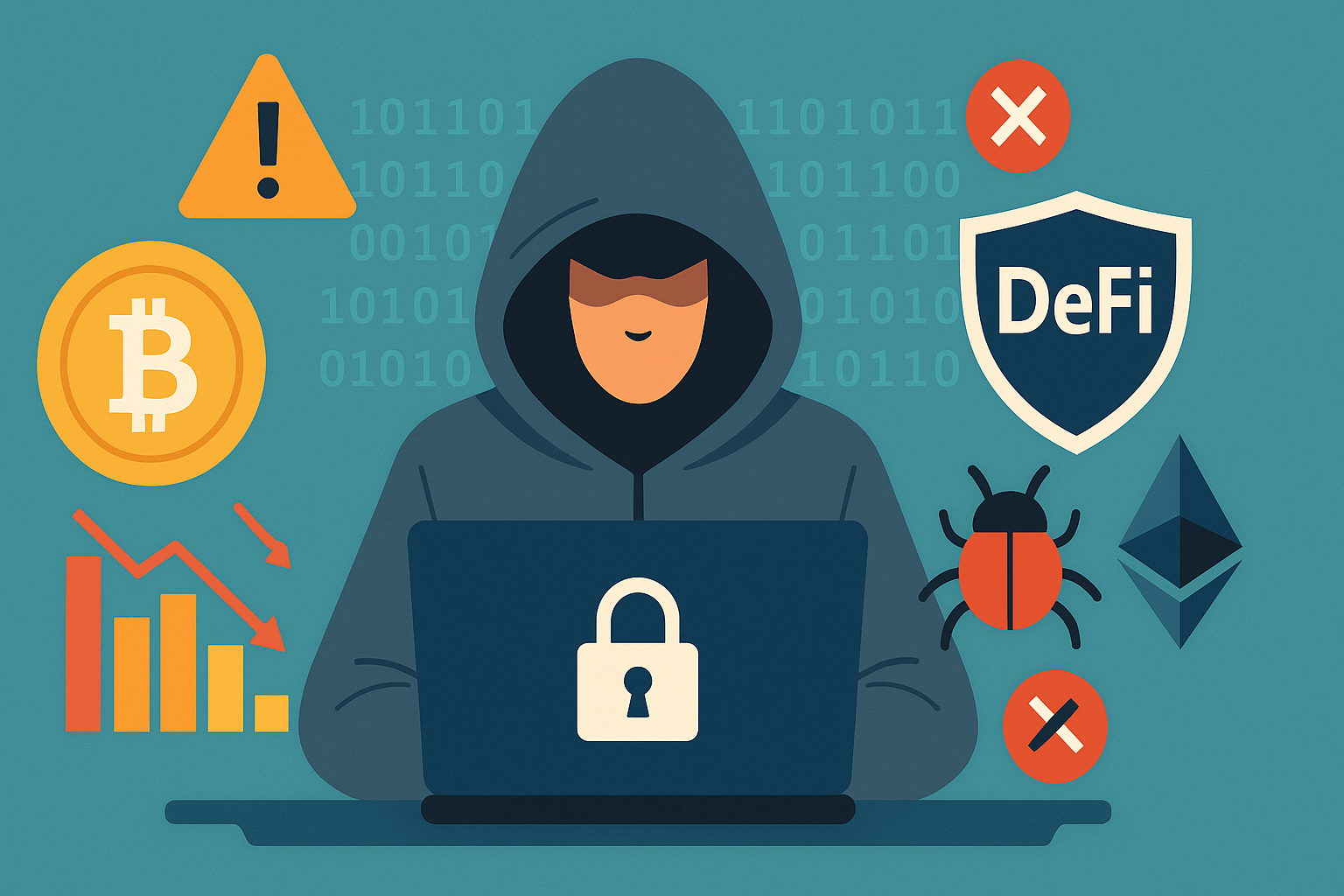
In 2025, decentralized finance continues to expand rapidly, attracting millions of users and billions in total value locked. But with that growth comes renewed attention from hackers. Several major exploits this year have shaken confidence and forced the DeFi community to confront one of its most persistent challenges: security. These incidents are serving as valuable lessons for developers, investors, and regulators as the industry matures.
The Scale of the Problem
DeFi’s open-source nature is both its strength and its vulnerability. Transparency allows innovation to thrive, but it also exposes potential weaknesses to bad actors. In 2025 alone, several high-profile breaches have resulted in hundreds of millions in losses across decentralized exchanges, lending protocols, and cross-chain bridges.
The majority of these attacks were not due to flaws in blockchain technology itself but in smart contract logic, oracle manipulation, or human error. As protocols grow more complex and interconnected, small oversights can lead to massive losses.
Key Exploits That Defined 2025
1. Oracle Manipulation and Price Feed Exploits
Attackers continue to exploit weaknesses in price oracle systems, which provide real-world data to smart contracts. In one major incident, a lending protocol suffered severe losses when attackers manipulated thinly traded token prices to borrow more than their collateral was worth. The exploit revealed that relying on a single data feed or low-liquidity asset remains a serious risk.
2. Cross-Chain Bridge Breaches
While interoperability has been one of 2025’s biggest technological advancements, it has also introduced new attack surfaces. Hackers targeted cross-chain bridges by exploiting faulty validation mechanisms between networks. These breaches have prompted developers to strengthen multi-signature controls, adopt decentralized validation layers, and limit bridge exposure through modular designs.
3. Governance Exploits
A few major DeFi projects faced governance attacks in which malicious actors accumulated governance tokens to pass proposals that drained treasury funds. These incidents highlighted the danger of poorly designed voting systems and low quorum thresholds. Some protocols are now implementing time delays on governance decisions and multi-layer approval mechanisms to prevent instant takeovers.
Lessons Learned for the Industry
1. Security Must Be Continuous, Not Occasional
Many projects relied on one-time audits and assumed that would be enough. The 2025 exploits proved that security is an ongoing process. Regular audits, continuous monitoring, and bounty programs are now becoming standard practice across top protocols.
2. Decentralized Oracles and Redundancy Matter
The reliance on a single data source remains a common vulnerability. Leading projects are now using multiple oracle providers and data aggregation techniques to ensure price accuracy and reduce manipulation risk.
3. User Education Is Part of Security
Several exploits succeeded because users interacted with malicious contracts or phishing interfaces. DeFi projects are investing in clearer user interfaces, wallet warnings, and education campaigns that help users verify contracts before signing transactions.
4. Code Transparency Must Be Matched by Accountability
Open-source code allows community review, but that alone is not enough. The DeFi community is now calling for higher accountability among developers, including identity verification for project founders, independent oversight boards, and standardized disclosure of vulnerabilities.
The Role of Regulation and Compliance
In response to the 2025 exploits, regulators in multiple regions have started collaborating with DeFi platforms to create standardized security frameworks. These include guidelines for code audits, liquidity management, and transaction monitoring. While some developers fear regulation may slow innovation, others see it as a necessary step toward legitimacy and investor protection.
The push for compliance is also attracting institutional capital. Funds and financial firms are more willing to participate in DeFi projects that meet clear security and governance standards. This shift is creating a more professional and risk-aware environment across the industry.
Building a Safer Future for DeFi
Security in DeFi is evolving from an afterthought to a primary design principle. Modern protocols are integrating on-chain risk assessment tools, automated incident response systems, and AI-powered anomaly detection to spot suspicious behavior before it becomes catastrophic.
Collaboration between security researchers, developers, and blockchain analytics firms is also improving. The community is learning to share data about vulnerabilities and exploits faster, allowing others to patch weaknesses before similar attacks occur.
Final Thoughts
The events of 2025 have reinforced a critical truth: DeFi’s success depends on trust, and trust depends on security. Every major exploit has delivered lessons that are shaping the next generation of decentralized finance.
While the industry can never completely eliminate risk, it can drastically reduce it through proactive design, continuous monitoring, and community accountability. DeFi is growing stronger not by avoiding challenges, but by learning from them. In the long run, these lessons will build a safer, more resilient ecosystem where innovation and protection advance together.