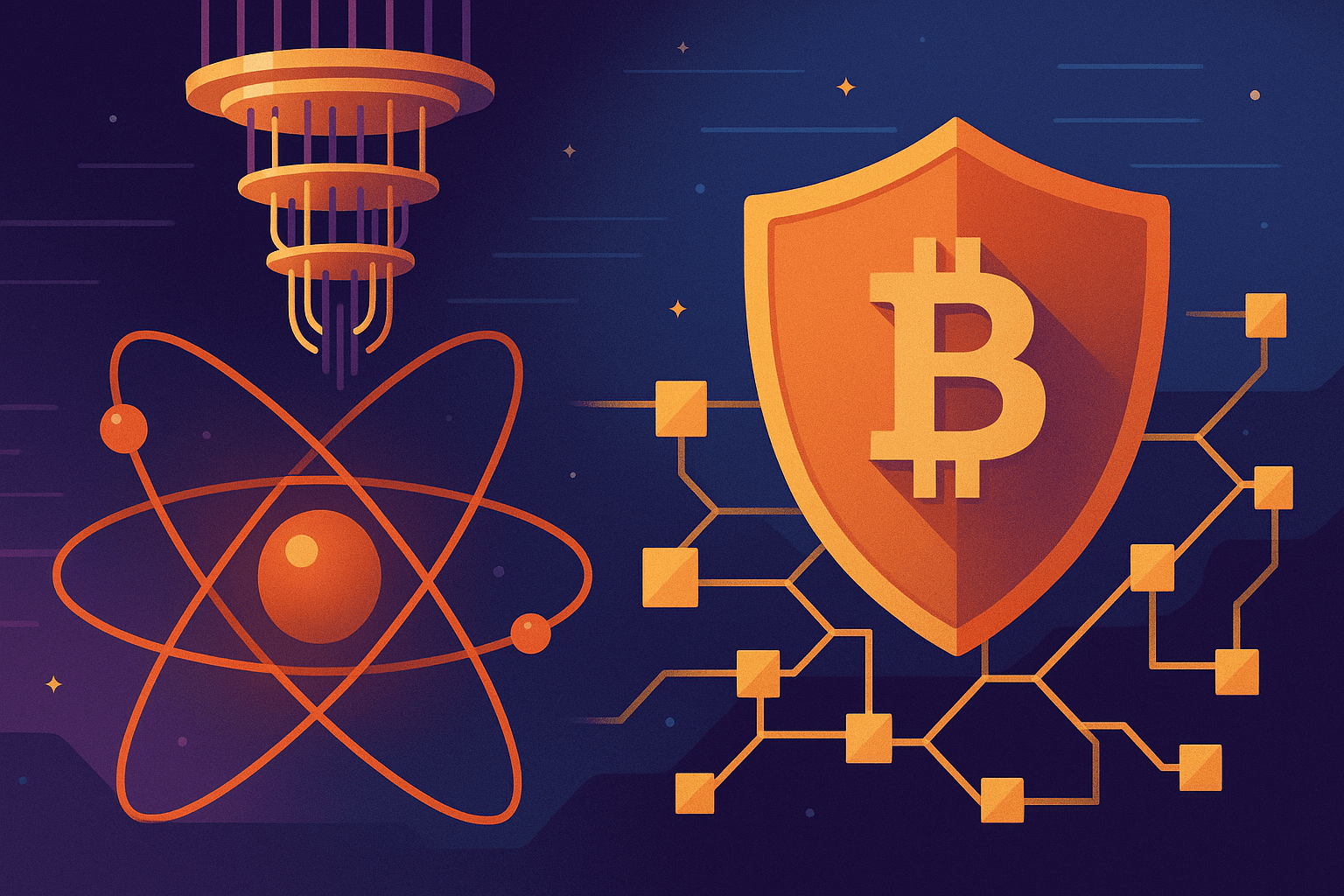
In 2025, the conversation around blockchain security has shifted from immediate threats like hacks and scams to something more futuristic and complex: quantum computing. As advances in quantum technology continue, researchers and developers are racing to ensure that blockchain systems remain secure in a world where quantum computers could, in theory, break today’s cryptography.
Why Quantum Computing Poses a Threat
Most modern blockchains rely on public key cryptography. This system uses mathematical problems that are easy to verify but extremely difficult to solve with current computers. Bitcoin, Ethereum, and most other networks depend on this principle to secure transactions and prevent unauthorized access to wallets.
Quantum computers, however, work differently. They process information using quantum bits, or qubits, which can represent multiple states at once. This allows them to perform complex calculations far faster than classical machines. If quantum computing continues to develop at its current pace, it could eventually crack the encryption methods that blockchains use to secure digital assets.
The Nature of the Risk
The most immediate concern is the potential vulnerability of private keys. A powerful enough quantum computer could theoretically derive a private key from a public address, giving access to any associated funds. While experts agree that large-scale quantum attacks are still years away, the blockchain industry is taking the possibility seriously.
Another risk involves digital signatures used in blockchain transactions. If these cryptographic signatures become easy to forge, it could undermine trust in the integrity of entire networks. Once the foundation of immutability is questioned, the value of digital assets could be at risk.
The Push for Quantum-Resistant Cryptography
To prepare for a post-quantum world, developers are creating new encryption systems designed to resist quantum attacks. Known as post-quantum cryptography, these algorithms use complex mathematical structures that remain secure even against quantum computing power.
Major blockchain projects are already testing these systems. Ethereum researchers, for example, are exploring signature schemes that could transition smoothly once quantum computers become capable of posing real threats. Smaller networks are also experimenting with hybrid solutions that combine classical and quantum-resistant encryption.
Governments and academic institutions are playing a major role as well. International standards bodies are reviewing algorithms that can serve as global benchmarks for quantum-safe cryptography. This collaboration between public and private sectors highlights how important it has become to prepare before the threat materializes.
Near-Term Security Measures
In the meantime, blockchain developers are implementing transitional solutions. Multi-signature wallets, hardware-based security modules, and encryption updates are helping to limit exposure. Some projects are moving toward address formats that conceal public keys until they are used, making it harder for attackers to target vulnerable addresses.
Education and awareness are also becoming central to the conversation. Investors and developers alike are learning that blockchain security is not static. It must evolve alongside advancements in computing.
A Long-Term Perspective
While quantum computing is still in its early stages, the blockchain industry is wise to prepare early. It may take years before a quantum computer capable of breaking today’s cryptography exists, but when that time comes, the transition to quantum-safe systems must already be in place.
The blockchain community’s proactive approach is a sign of maturity. Rather than waiting for a crisis, it is working now to future-proof the technology that underpins decentralized finance and digital ownership.
Final Thoughts
Quantum computing represents both a challenge and an opportunity for blockchain innovation. It forces developers to rethink security from the ground up and create more advanced systems that can stand the test of time. In 2025, the fear of quantum attacks is not driving panic, it is driving progress. The networks that adapt first will not only survive but set the standard for the next era of digital trust.