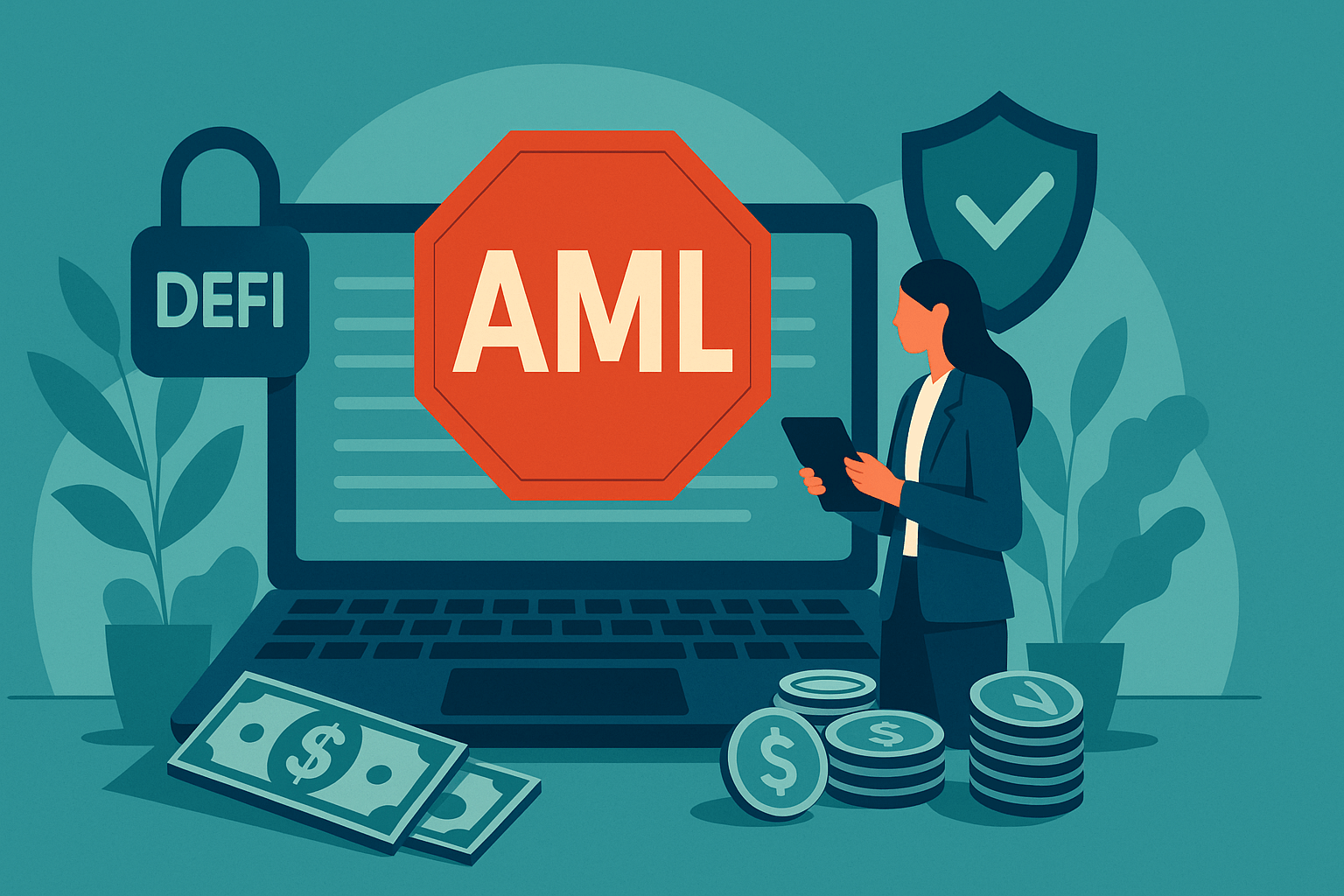
In 2025, decentralized finance (DeFi) is facing one of its biggest transformations yet. Governments across the world are tightening anti-money laundering (AML) regulations, forcing DeFi platforms to adapt. What was once a space defined by anonymity and full decentralization is now evolving toward greater transparency, accountability, and compliance.
Why AML Regulations Matter
Anti-money laundering laws are designed to prevent the use of financial systems for illegal activities such as fraud, terrorism financing, and tax evasion. In traditional finance, these laws are enforced through identity verification, transaction monitoring, and reporting requirements. For years, DeFi operated largely outside this framework, using smart contracts and pseudonymous wallets that offered limited oversight.
As the sector has grown to hold hundreds of billions in total value, regulators have taken notice. DeFi is no longer viewed as a small experiment but as a system capable of influencing global financial stability. The challenge now is how to integrate compliance standards without undermining decentralization itself.
The Shift Toward Transparency
In 2025, major DeFi protocols are introducing features that align with global AML guidelines. Many platforms are adopting on-chain identity verification tools that allow users to prove compliance without revealing private details. These systems use technologies such as zero-knowledge proofs to confirm that users meet legal requirements while preserving privacy.
Smart contracts are also being designed to include compliance checkpoints. Transactions that exceed certain thresholds or come from flagged addresses can be automatically paused or rejected. These mechanisms are helping DeFi align with regulations while maintaining its core principle of code-based governance.
Regulatory Developments by Region
United States
The United States has taken a leading role in shaping AML enforcement for digital assets. Regulators now require decentralized platforms that offer financial services to register or partner with compliant entities. Many DeFi projects have responded by integrating Know Your Customer (KYC) solutions or limiting access for unverified users.
European Union
Europe’s Markets in Crypto-Assets Regulation (MiCA) has expanded to cover DeFi applications, with a strong focus on transparency and consumer protection. Platforms must ensure traceability of transactions and report suspicious activity to authorities. The result has been a rise in hybrid platforms that combine decentralization with compliance-friendly structures.
Asia-Pacific
In countries such as Singapore, Japan, and South Korea, regulators are balancing innovation with control. These markets have developed frameworks that encourage DeFi growth while mandating strict identity verification for high-value transactions. The approach emphasizes collaboration between regulators and developers rather than confrontation.
The Impact on DeFi Projects
The introduction of AML rules is reshaping how DeFi projects operate. Teams are now investing heavily in compliance infrastructure and legal consultation. Some projects are migrating to permissioned blockchains, where access is limited to verified participants. Others are building partnerships with traditional financial institutions to bridge compliance gaps.
Liquidity pools and decentralized exchanges are also adapting. Platforms are implementing smart monitoring tools that identify suspicious activity while still allowing peer-to-peer trading. This creates a middle ground where legitimate users can transact freely, and illegal activity is minimized.
Balancing Innovation and Regulation
The challenge for the DeFi industry lies in balancing compliance with innovation. Too much regulation could stifle creativity and drive developers away from open networks. Too little could lead to misuse and undermine public trust.
To achieve this balance, developers are exploring decentralized compliance frameworks that rely on open-source standards rather than centralized control. These frameworks allow protocols to verify users, monitor flows, and meet reporting obligations without compromising autonomy.
Community governance is also playing a role. Token holders are voting on proposals to add AML compliance features, demonstrating that self-regulation can work within decentralized systems.
The Future of DeFi Compliance
As the sector matures, compliance will likely become a competitive advantage rather than a burden. Platforms that integrate AML tools seamlessly will attract institutional investors, who demand transparency and risk control. In fact, many traditional firms are now exploring partnerships with compliant DeFi platforms to access yield opportunities in a regulated environment.
Meanwhile, regulators are starting to recognize the potential of decentralized technology to improve oversight. Automated smart contract reporting and blockchain analytics are giving authorities new tools to track suspicious behavior more efficiently than in traditional finance.
Final Thoughts
The tightening of anti-money laundering laws marks a turning point for decentralized finance. What once thrived on complete anonymity is now evolving toward responsible transparency. The DeFi platforms that embrace this shift will lead the next phase of growth, bridging the gap between open innovation and regulatory trust.
In 2025, compliance is no longer the enemy of decentralization, it is becoming the foundation that will allow DeFi to expand globally, attract institutional participation, and prove that financial freedom and accountability can coexist.